
Last updated: October 11, 2026
Key Takeaways
- Publishable output comes from a narrow workflow, not from trying to make the model clever.
- The right template is determined by risk, not format alone.
- A useful first draft begins with a brief that answers six plain-language questions.
- The answer changes when risk, volume, or subject-matter depth changes.
If you need a human + AI content team to publish consistently, the answer is to separate judgment from drafting, then run every piece through the same checkpoints. That setup works best when the team has clear handoffs, fixed review rules, and a small set of templates that fit the job: blog piece, landing page, email, or update. For human + AI content teams: workflow templates for consistent, publishable output, the goal is to make each piece predictable enough to review and ship.
I’m writing for the editor, marketer, or founder who already knows AI can help, but wants output that is actually publishable. The core problem is not “how do I get AI to write?” It is “how do I keep quality stable when several people and one model touch the same piece?”
What actually makes a human + AI workflow publishable?

Publishable output comes from a narrow workflow, not from asking the model to be clever. If the draft has a clear brief, a named owner, one source of truth, and a final human review, the odds improve fast. If any of those are missing, the output tends to drift into generic advice, repetition, or quiet factual errors.
The simplest useful structure is: strategy first, outline second, draft third, fact-check fourth, polish fifth. A team that skips the outline usually pays for it later in rewrites. A team that skips fact-checking gets burned on claims the model sounded confident about. This is where a tool like ChatGPT, Claude, or Gemini helps with speed, but not with accountability.
According to McKinsey, generative AI can automate tasks that account for 60% to 70% of employees’ time, which is why workflow design matters more than prompt tricks. Here is the decision table I would use:
| Situation | Best Path | Why Other Options Fail |
|---|---|---|
| Small team, 1 editor, 1 writer, 1 reviewer | Use a 5-step template with one owner per step | Shared ownership creates edit loops |
| Subject-matter-heavy piece | Human writes the outline and claim list before AI drafts | AI fills gaps with plausible nonsense |
| High-volume, lower-risk pieces | AI drafts from a fixed brief; human edits for style and accuracy | Fully manual writing is too slow |
| Brand-sensitive page | Human writes first draft; AI only assists with structure and cleanup | AI-first can flatten voice and intent |
If you want a stable system, I would choose fewer templates, not more. A team of three does not need seven workflows. It needs one workflow that handles most jobs and one exception path for sensitive pieces.
- Assign one owner for the piece before any drafting begins.
- Write a brief with audience, job, angle, proof points, and forbidden claims.
- Have AI generate an outline, not the final piece, unless the topic is low-risk.
- Have the human draft or revise section by section against the brief.
- Run a fact pass on every concrete claim, name, date, and number.
- Do a final voice and format edit before publish.
That is the core template. It sounds basic because it is. The hidden work is in the brief. A weak brief produces weak AI output every time.
Quick check: If your team argues about quality more than speed, the workflow is too loose; if your pieces are fast but generic, the brief is too thin.
Which template should you use for a blog piece, landing page, or newsletter?
The right template depends on risk, not on format alone. A 1,500-word thought piece can tolerate more AI drafting than a pricing page or a medical explainer. If the page can hurt trust, then humans need to own the claims and structure. If the page mainly needs consistency and throughput, AI can draft more of it.
For blog pieces, I prefer a human-led outline with AI-assisted drafting. For landing pages, I want the human to set the promise and proof before AI writes a single sentence. For newsletters, I would use AI to summarize source material, then let a human add judgment and voice. The difference matters because a newsletter can sound conversational while still being wrong; a landing page can sound polished while still failing to convert.
Use this as the split:
- Blog piece: AI drafts sections from a detailed outline; human edits for accuracy and examples.
- Landing page: Human writes the offer, objections, and proof; AI helps compress and vary wording.
- Newsletter: AI summarizes links or notes; human chooses what matters and what gets cut.
- Internal memo: AI can do more drafting, because the audience already knows the context.
If your piece depends on current facts, laws, product details, or medical claims, then the template changes again. I would not let the model invent the factual spine of the draft. That job belongs to the person who can verify sources such as the FTC, NIH, CMS, or a standards body like NIST, depending on the topic.
A practical 5-step landing page template looks like this:
- Write the offer in one sentence, with the audience named.
- List the top 3 objections that must be answered on the page.
- Collect proof: testimonials, numbers you can verify, screenshots, or policy details.
- Ask AI to draft only the sections that do not carry legal or factual risk.
- Have a human compress, reorder, and sanity-check the final page.
The trade-off is obvious: the more important the page, the less you should delegate the core claim. That does make the workflow slower. It also makes it safer.
Quick check: If the page has a promise someone could challenge, use a human-led template; if it is mainly explanatory, AI can do more of the drafting.
How do I brief AI so the first draft is useful?

A useful first draft starts with a brief that answers six questions in plain language. If the brief does not name the audience, purpose, angle, proof, tone, and constraints, the model will improvise. That improvisation is where most bad drafts begin.
I would keep the brief to one page, or even half a page, but it needs real detail. “Write about AI content workflows” is not a brief. “Write for a content manager at a B2B software company who needs a 6-step workflow for a two-person team using Notion, Google Docs, and ChatGPT, with an emphasis on review checkpoints and avoiding factual drift” is much closer.
Use this template:
- Audience: Who will read it and what do they already know?
- Job: What should they do after reading?
- Angle: What is the main point, not just the topic?
- Proof: Which facts, examples, tools, or standards may appear?
- Tone: Direct, formal, conversational, skeptical, etc.
- Constraints: Word count, banned claims, required sections, and anything not to mention.
Then add one more thing: a “do not guess” rule. Tell the model to leave placeholders where verification is needed. This matters for software pages because pricing, plan names, and feature availability change often. It also matters for anything that touches policy, compliance, or health guidance.
A workflow that often works well is:
- Human writes the brief and marks required facts.
- AI produces an outline with 5 to 7 sections.
- Human deletes weak sections before drafting starts.
- AI drafts from the approved outline only.
- Human fact-checks against source documents, not memory.
- Human edits for voice and removes repeated phrasing.
The main trade-off is speed versus control. A fuller brief takes 10 to 20 minutes longer at the start, but it can cut a much longer rewrite later. That is usually the better bargain.
Quick check: If your pieces keep missing the point, your brief is too vague; if they keep sounding stiff, your tone and angle are too restrictive.
The 3 conditions that change everything
The answer flips when risk, volume, or subject-matter depth changes. If all three are low, AI can carry more of the load. If any one of them is high, humans need more control points. That is the part generic advice misses.
Condition 1: High factual risk. If the piece mentions laws, prices, medical advice, regulated claims, or technical standards, then the human should own the source check. A model like GPT-4.1 or Claude may draft the frame, but it should not be the authority. Use original sources, not a polished summary.
Condition 2: High volume. If you need 30 pieces a month, the workflow has to standardize inputs. That means templates, snippets, reusable outlines, and a library of approved examples. The cost is variety. The gain is throughput.
Condition 3: High brand sensitivity. If the audience is paying attention to voice, then AI should assist, not lead. That is true for a founder-led brand, an executive newsletter, or any page where the phrasing itself is part of the value.
A good operating rule is this: the more expensive the mistake, the more human checkpoints you need. That is why a newsy or regulated piece needs a different template than a simple “how-to.” The model can still help with summaries, structure, and cleanup, but the final judgment stays human.
One honest limitation: if your team expects AI to remove the need for subject expertise, it will disappoint you. It can reduce drafting time. It cannot replace domain knowledge, especially when the task is choosing what not to say.
Quick check: If the piece can be wrong in a way that costs trust or money, slow the workflow down and add review gates.
Human + AI content teams: edge cases where normal advice breaks down
Normal advice breaks down when the draft has unusual constraints, and those cases need special handling. Here are the ones I would plan for.
-
Situation: legal, medical, or financial claims.
What changes: verification matters more than style.
What to do instead: have a qualified reviewer check claims against primary sources such as government agencies, professional associations, or standards bodies before the draft is finalized. A polished model output is not enough. -
Situation: the source material is messy notes, recordings, or screenshots.
What changes: AI can summarize, but it can also misread context.
What to do instead: human clean-up comes first. Label each source, extract quotes carefully, and only then let AI organize the material. -
Situation: the brand voice is unusually distinctive.
What changes: generic phrasing becomes more damaging.
What to do instead: give the model 3 to 5 examples of approved copy and explicitly ban certain clichés. Then have a human rewrite the opening and closing. -
Situation: the deadline is same-day.
What changes: the workflow must shrink.
What to do instead: use a “minimum viable publishable” path: outline, draft, fact scan, final edit. Skip extra rounds unless the topic is high-risk. -
Situation: multiple stakeholders want edits.
What changes: AI can make the piece longer, but not clearer.
What to do instead: assign one decision-maker to merge comments, or the piece will become a pile of contradictions.
For governance and process discipline, I also like pointing teams to NIST’s AI Risk Management Framework and the FTC’s guidance on misleading claims. Those are not writing manuals, but they help define what “safe enough to publish” means in practice.
Quick check: If your biggest problem is not writing speed but source quality, stakeholder conflict, or regulated claims, you need a special-case workflow, not the standard one.
A workflow I would actually hand to a team
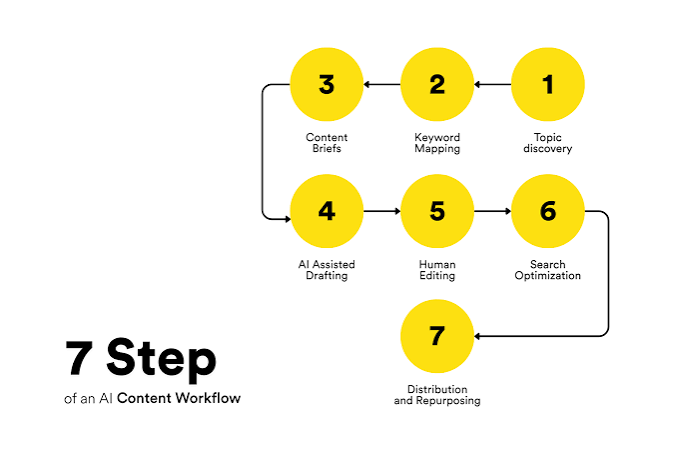
The workflow I would choose is the one that can survive vacation, deadlines, and a bad first draft. It is a six-stage system with one owner, one brief, one review pass for facts, and one final editor. That is boring on purpose. Boring scales better than clever.
Here is the version I would hand to a 2- to 5-person team using tools like Google Docs, Notion, and ChatGPT:
- Intake: the owner defines audience, goal, and risk level.
- Brief: the editor writes a one-page brief with source links and forbidden claims.
- Outline: AI proposes structure; the human cuts weak sections.
- Draft: AI drafts only approved sections, or the human drafts the risky parts first.
- Verify: the reviewer checks every number, name, quote, and external reference.
- Polish: the editor fixes rhythm, repetition, headings, and CTA placement.
If you want consistency, use a checklist at the end of every draft. Mine would include: does the opening state the answer in the first sentence, does each section add new information, are there any unsupported claims, and does the piece sound like one person wrote it?
The biggest trade-off with this workflow is that it can feel slower at the start than “just ask AI to write it.” That feeling is real. So is the payoff: fewer rewrites, fewer factual misses, and less time spent rescuing a piece that wandered off course.
This is not the right system for a solo creator who wants quick experiments and does not care if half the pieces are rough. It is for teams that need dependable output they can stand behind.
Quick check: If you need repeatable quality across many pieces, use a fixed six-stage workflow; if you need speed for low-stakes experimentation, simplify it.
FAQ
What is the biggest mistake teams make with AI writing?
They let the model set the angle before the human has set the brief. That usually leads to generic structure and weak judgment.
Should the human write first or should AI write first?
For high-risk or brand-sensitive work, the human should write the outline or key claims first. For lower-risk work, AI can draft from a strong brief.
Do I
Drafted with AI; not yet reviewed by a person.